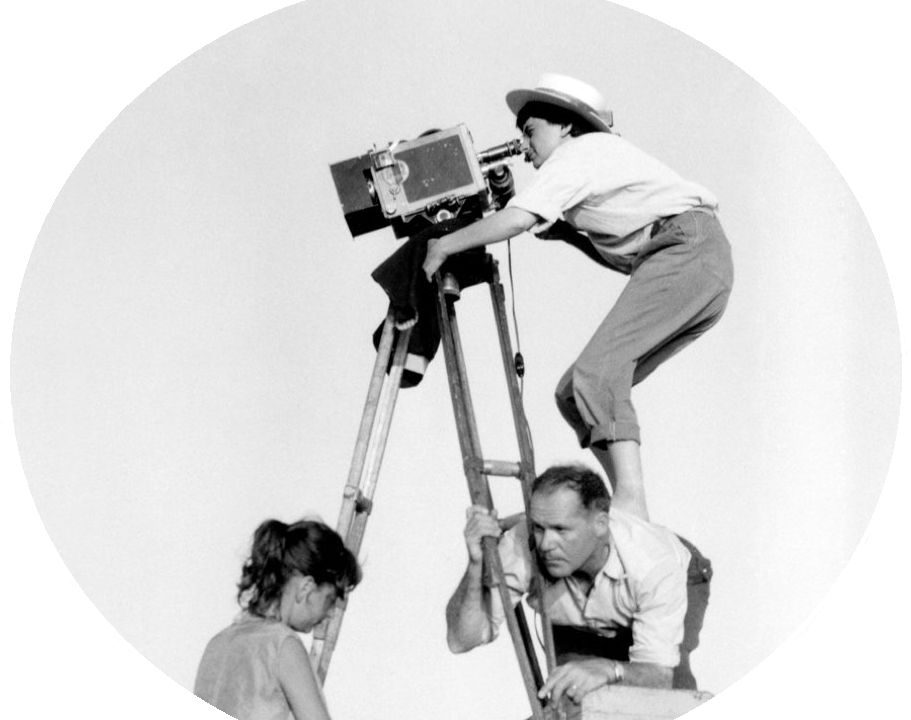
Hollywood Hotel (1937)
Tuesday, July 1, 2008
Once again, I remind everyone that my entries contain spoilers! TCM will be airing "Hollywood Hotel" on July 2nd at 8:00 PM Eastern, and the film is also included in a new Busby Berkeley box set due out September 19th. Don't read any further if you don't want to be spoiled!
"Hollywood Hotel" is a Busby Berkeley comedy musical that, oddly enough, doesn't contain a single Berkeley-standard geometric dance extravaganza. There's lots of singing but very little dancing, and the film is uneven in spots, but when it's good, boy is it good!
The opening strains of "Hooray for Hollywood" greet us as we see a series of signs warning the big stars of the screen to watch out, because Ronnie Bowers is coming to town. Ronnie (Dick Powell) is a sax player for a St. Louis band headed by Benny Goodman, and he's off to Hollywood with a 10-week contract to the All-Star Studio. Benny and band drive to the St. Louis airport in jeeps, standing and playing all the way to cheer their friend on. "Hooray for Hollywood" starts up in earnest as Johnnie 'Scat' Davis sings the now-classic tune, accompanied by Frances Langford.
Ronnie flies to Hollywood as "California Here I Come" plays brightly during a montage of the town that includes the Brown Derby, the Cocoanut Grove, and other famous locales. Thankfully they didn't use really old stock footage like many 1930s films did, or if they did it wasn't very noticeable. Nothing throws my suspension of disbelief off faster than watching footage shot in 1925 used in a 1937 film.
When Ronnie steps off the plane he is greeted by All-Star PR man Bernie Walton (Allyn Joslyn) and photographer (Eddie Acuff). Meanwhile Fuzzy (Ted Healy), an independent photographer, shows up to also get photos of Ronnie. Bernie and Fuzzy don't like each other much, and a few zingers are exchanged.
During this entire sequence of leaving and arriving in Hollywood, everyone has terrific dialogue. It's funny and hip and even though most of those we see on screen aren't good actors, you cannot help but enjoy yourself. All that said, one of the funniest moments occurs between Joslyn and Acuff as they wait for the new star to get off the plane:CAMERAMAN: They're not gonna make a picture star outta him?
Most of Acuff's lines are said without emphasis and much too quickly, but his delivery of this punchline is spot-on solid.
BERNIE: Why not? They made one out of Rin Tin Tin.
CAMERAMAN: Yeah, but he could bark.
Bernie is clearly unimpressed with Ronnie and drops him off at the famed Hollywood Hotel with the instructions to stay put until he's called. Ronnie checks in and is starstruck by the excitement in the lobby, which is in an uproar because of their most famous guest, Mona Marshall. He's distracted by the hotel's famous Orchid Room, where he's heard many radio broadcasts, but is brought back to the check-in desk by the porter. The manager and employees are initially impressed with their new All-Star actor guest, but when Ronnie tells the hotel manager that he's a saxophone player, the manager changes Ronnie's room and the porter scowls at him. Powell is quite good at playing the Hollywood newbie without overplaying the role. His Ronnie is excited about his new life but isn't overzealous, and he shows his inexperienced goofiness but avoids becoming irritating.
While this is going on, Mona's father Chester Marshall (Hugh Herbert, last mentioned on SBBN here) is being paged. He is found but confused, doing his standard mutter-and-act-goofy-while-woo-wooing shtick, but it provides an adequate segue away from Ronnie and to Chester's daughter Mona, a big Hollywood film star.
Mona Marshall is fussing and swooning and generally acting like a drama queen in her dazzling hotel room, surrounded by a large entourage. Mona (Lola Lane, one of the Lane Sisters) is having a dress fitted and she and the designer seem intent on out-doing each other in histrionics. The designer, Butch -- played as a real "Don't mind me dear!" caricature by Curt Bois -- is beside himself. Butch is also subject to a few questions regarding his sexuality by Mona's competent assistant Miss Jones (Glenda Farrell). Mona is being interviewed by Louella Parsons (played by herself) as she temperamentally rants about ridiculous things. Not only is she difficult and rude, she's also quite dim. She ends her over-the-top performance by photogenically grasping each side of her neck and moaning, "Oh, my thyroids!"
Mona's sister Dot (Mabel Todd) arrives and proves that the whole family is comprised of fools. Mabel Todd may be the most irritating person ever put on screen, and I say that as someone who has seen several Adam Sandler movies. Let's just say she's shrill and leave it at that. As Louella asks Dot a few questions, Mona answers for her -- even Mona knows Dot is as dumb as a bowl of mice -- and Dot starts to pick her nose. Ugh.
Famous movie star Alexander 'Alec' Dupre (Alan Mowbray, last mentioned on SBBN here) arrives in Mona's suite. Parsons asks if their romance is headed towards marriage, and they both remain coy on the subject. Mona tells Parsons that she and Alec will be in the upcoming sure-fire hit "Bitter Night", but Alec informs Mona that's not true. In fact, Parsons herself reported in that morning's trade paper that other actors were chosen.
Mona goes a bit Norma Desmond from the disappointment and decides to not go to that night's film premier, just to stick it to the studio that didn't give her the "Bitter Night" role. This puts B.L, the head of All-Star Studios, in a jam. Mona is nowhere to be found and they need their star to show up to her own film premier. Bernie the PR guy comes up with an idea: find a look-alike for Mona and send her to the premier instead.
Bernie looks over a host of young starlets and finds Virginia (Rosemary Lane, sister of Lola Lane who plays Mona) and chooses her. Virginia is a waitress who can't get any work in town because she looks too much like Mona, but when she shows she can convincingly act like Mona she's hired for the premier. Bernie chooses Ronnie for Virginia's date, because Ronnie is the only
All-Star actor who hasn't seen Mona in person, therefore he wouldn't catch on to the scam and accidentally spill the beans.
Virginia is given a make-over by none other than Perc Westmore! Not only did I finally get to see Perc in action, but I finally got confirmation that his name is pronounced like "purse" and not "perk", too. You can see him here dressed like a pharmacist, making Rosemary Lane in the chair look like Lola Lane in the photo. Perc's abilities are undeniable, but you have to admit, this job isn't too difficult since the actresses are sisters.
Ronnie arrives at Mona's suite while Virginia is getting ready. Meanwhile Alec shows up, also unaware that Mona is gone and a look-alike is in her place. The maid is in on the scheme and worries about Alec's arrival, so Ronnie helpfully tells Alec to go away. Alec refuses and causes a scene, and Ronnie decks him in response.
Ronnie and Virginia go to the premier, and Virginia fools everyone. They are both interviewed for the radio by none other than Ronald Reagan in his second film role; he had just signed a contract with Warner Brothers that year. Ronnie (Dick Powell, not Ronnie Reagan) gets flustered and starts to act like a doof, so Reagan quickly shoos him off the mic and into the premier.
Virgina and Ronnie head to the Orchid Room after the premier and enjoy a dance together, which turns into a lovely duet between them called "I'm Like a Fish Out of Water", shot on a surprisingly tasteful fountain set. Virginia and Ronnie are hitting it off. Mona's sister Dot and the photographer Fuzzy also do their own version of the song as Dot pursues an unwilling Fuzzy through the fountain.
The next morning Mona finds out that a look-alike was used for the premier and explodes in anger. She flies right back to the All-Star Studios and confronts B.L. and Bernie. When Ronnie arrives she slaps him, which he doesn't understand because he thinks Mona and Virginia are the same person. While standing there stunned, Bernie tells him that Mona has insisted that Ronnie's contract be bought out. Ronnie has been fired.
Ronnie hooks up with Fuzzy, who makes himself Ronnie's new manager, but they run into Bernie almost immediately. Bernie insists they talk at a coffee shop in the Hollywood Hotel. The waitress arrives to take their order and it's Virginia, who denies knowing Ronnie at first. Ronnie runs off and sees Mona in the lobby, which makes him even more confused. Bernie explains that Virginia is the one he went on a date with, and Mona is the real actress. Meanwhile Mona, her crazy father, her moron sister, and Miss Jones -- you gotta feel sorry for Glenda Farrell in this scene -- all lose control of the dogs they were walking through the lobby. Was a silly dogs-running-about scene necessary?
I do think that this scene indicates the turning point in the film. From personal experience, it seems as though "Hollywood Hotel" is not very well liked. There are precious few reviews of the film, not much written about it, and what is out there is often quite convoluted; Mark Deming's plot summary for "Hollywood Hotel" in the All Movie Guide is so completely wrong that it seems almost deliberate.
I think there are several reasons for the film's lack of popularity. First, this is a Busby Berkeley movie without the fabulous geometric showgirls. Second, the film features a lot of unconnected musical moments tied together by the thinnest of plot threads. Musically, there are some amazing gems, like "Hooray for Hollywood" introduced by Johnnie Scat Davis, and Benny Goodman and Gene Krupa perform "Sing Sing Sing", but the majority of musical numbers are forgettable. Also, the witty dialogue is primarily in the first few reels of the film, with the dialogue in the second half often calling back to jokes we already heard. This second half of the movie slows down as the music takes over, as well, by a rather tedious romance and some tepid "wacky hijinks".
Ronnie and Virginia go on a date and end the evening at the Hollywood Bowl. In some of the previously-mentioned callback dialogue, Virginia recites the names of every famous landmark we saw in the opening montage, saying they had visited each place. Ronnie says he wants to see the Bowl, though, so Virginia shows him how to get in even when it's closed. There she sings "Silhouetted in the Moonlight" rather weakly. Berkeley also inexplicably decides to put Powell in an obviously fake nighttime set with blinking lights on a black background. With every other set realistic, this cardboard-and-Christmas-lights design truly stands out.
The next day Ronnie and Fuzzy head out to find Ronnie a new studio. They hit Miracle Pictures first ("If it's a good picture it's a miracle" -- that joke never gets old!) and continue on to a dozen studios, none are interested. Afterwards they step into a pawn shop to sell Ronnie's sax for money. Why was that necessary? They'd bought a car with Ronnie's money, but surely selling the car would get you more money than a sax. But selling the sax is a good segue into meeting old pals Benny Goodman, Johnnie Davis and Frances Langford in the street. The orchestra has gotten a gig at the Orchid Room. Ronnie is about to tell them he got fired when Fuzzy interrupts and says that Ronnie is on break from shooting a film at that moment.
In fact, Ronnie and Fuzzy get jobs at the local burger joint, a drive-in owned by Callaghan (Edgar Kennedy) and a mimic of the real-life "Carpenter's" in Hollywood. While there Ronnie launches into a musical number that turns into a lengthy event with all the guests and employees joining in. Edgar Kennedy does his patented slow burn and fires both Ronnie and Fuzzy, who don't care because a producer from All-Stars was at the drive-in and has offered Ronnie a job on his film. Virginia, however, is not happy about this, saying that she knows the ropes and Ronnie should keep his job until he knows he really has a role in the film. All-Stars screwed him over once and she thinks they may screw him over again. Ronnie disagrees. They fight and she leaves.
The next day Ronnie arrives on the set. It's a movie set in the American South during the Civil War. Mona is in the lead as a Southern belle, with Alexander Dupre as her lover and soldier. They are filming a scene where Mona and Alec both act with ridiculous condescension to the black slaves, but that moment is ruined when Hugh Herbert shows up again. Mona's father has donned blackface and joined a group of the slaves in the film. He jumps up and shouts in some stereotypical "slave" lingo, then calls himself "Uncle Tom". The director angrily yells at Mona's father, calls him a "monkey," and I don't remember what else happens because at that moment I became complete skeeved out.
Many people can view scenes like these in a detached manner, as a product of another time, but long-time readers of my blog know I cannot do this. Berkeley has a history of issues with people of color in film, most notably as the designer of the "watermelon" number in "Wonder Bar" (1934). The over-the-top racism in this film is jarring and unnecessary -- I didn't need to say it was unnecessary, did I? I hope not -- and it's frustrating to see a movie fall back on racist humor because it's floundering. And that's exactly how Herbert's scene comes off.The scene with Herbert was beyond unsettling, but for the most part, "Hollywood Hotel" is guilty of no more than every A-list film of the 1930s was: giving people of color roles only as servants, porters, or slaves in historical epics. Mona's maid Cleo, played by Libby Taylor, has a decent-sized role and is not played for racist laughs, but you can't help but forget that she never would have been given an opportunity to play anything but a maid. Taylor wasn't credited in the film, either, despite appearing in several scenes. Taylor was Mae West's own maid who appeared as Tira's maid in "I'm No Angel", and was the cook who helped Madge wine and dine Marvin in "Cabin in the Cotton". She appeared in nearly 60 films over a 20-year career, and almost always played a maid.
All of Mona's relatives are unnecessary characters. Dot was clearly created as a way to squeeze Mabel Todd into the film, just as Chester was created for Hugh Herbert. Their inclusion was as comedy relief, but in a film where Lola Lane, Ted Healy and Glenda Farrell are already providing substantial comedy, the addition of two people purely for wacky hijinks was pointless. Martin Rubin in his book Showstoppers felt that the movie had an overabundance of eccentric characters without enough everyday joes to balance it out. He also makes a good case in showing that Berkeley's grandiose visual spectacles, even when somewhat subdued as in "Hollywood Hotel", don't always mesh well with screwball comedy. A "light touch" is needed, and Berkeley simply didn't have it.
Ronnie discovers that the producer didn't want him for an acting gig, he was hired to sing, specifically to dub in for Alec's songs in the film. He won't get credited but he will get paid. He reluctantly agrees and attends the premier (where you see the program spell Alec's last name as "DuPrey", although it is supposed to be "Dupre"). Ronnie decides enough is enough and he runs off into "hiding", which just means going back to Callaghan's with Fuzzy, but in this film it's enough to make people issue an APB for him because he's so well-hidden.
All-Stars is desperate to find Ronnie because Alec has promised to sing at the Orchid Room. Since he can't sing, they want to use Ronnie to sing in another room and make it look as though Alec is singing. Sound familiar? This scenario is a rather important plot point in "Singin' in the Rain", a movie made 15 years later. "Singin' in the Rain" isn't much more than borrowed elements from early Hollywood musicals, with a dash of silent-film-hate thrown in. But I digress again. Moving on...Fuzzy hears that All-Stars wants Ronnie back, so he contacts Virginia who shows up at Callaghan's to talk Ronnie into returning. He refuses at first. However, Mona's dad shows up for no logical reason and decides to concoct a plot using Virginia as a decoy, also for no logical reason.
Virginia makes herself up as Mona again and picks up Alec for his night at the Orchid Room. Alec figures the scheme out and demands to be let out of the car. He's stranded on the side of the road and cannot arrive to the Orchid Room in time. Meanwhile Mona's father keeps her occupied as well, just long enough for Ronnie to perform at the Orchid Room instead, to much acclaim. The set here is beautiful, with all the singers on stages made to look like giant orchids, and the winding railings throughout the room covered in large vines.
Mona eventually arrives and has another fit, turning into a martyr and saying she'll step aside if the fans really want Virginia instead of her. Virginia takes her up on it and goes out to perform with Ronnie. Everyone's happy and the film ends.
Although honestly, I don't think Virginia got anything out of the deal, as the audience surely thought she was Mona and Mona would get all the credit.
Like many musicals of the 1930s, this film relies on the strength of the humor between each musical song or dance segment. It unfortunately runs out of steam; when it does, the audience discovers how important energy and charm are to films like "Hollywood Hotel".
This is an enjoyable film, no question. Lola and Rosemary Lane are both quite good in the film, and the people playing themselves -- Louella Parsons, Benny Goodman, Perc Westmore, etc. -- are all reasonably competent at their roles. Dick Powell is so adorable I want to take him home and feed him a saucer of milk, and give him a little yarn toy and some catnip...
What? Don't look at me like that.As for the film's problems, it's probably selfish of me to want a movie to keep the high-energy pace throughout the entire film, and I feel a bit spoiled complaining about the last few reels of the film when the first half was so amazing. Plus, I know my taste in humor tends away from the silly characters with little importance in the film, and I know most people who love classic film really enjoy the wacky hijinks. If you get a chance to see this film, you should.
FURTHER READING & CREDITS:
"Hollywood Hotel" at Laura's Miscellaneous Musings
"Hollywood Hotel" and Louella Parsons' radio program at Thrilling Days of Yesteryear
Solid! Johnnie Scat Davis biography
Showstoppers: Busby Berkeley and the Tradition of Spectacle by Martin Rubin, pages 136-138
Thanks to amy_jeanne at LiveJournal for the publicity still
Posted by Stacia at 5:06 AM 7 comments
Labels: film, set your recorders
Jewel Robbery (1932)
Saturday, June 21, 2008
"Jewel Robbery" is a delightful pre-code romance set in Vienna. Starring Kay Francis and William Powell, this film is shamefully unavailable in any format. However, TCM will be showing "Jewel Robbery" on September 4 at 8:15 PM Central. Actually, the entire month is Kay Francis month -- the last time Kay was the featured star was close to 10 years ago, and it's not hyperbole for me to say that month changed my life. I stayed up all night to watch Kay's films and a whole new genre and era of film-making opened up for me. I especially fell in love with the Kay Francis-George Brent-Lyle Talbot trio.
At the time I didn't realize that so many of the films I was watching were rare, so I didn't record anything; this year I will not make that same mistake. I don't want you to make the same mistake either! Don't miss a rare opportunity to see "Jewel Robbery" and other films, such as "Mandalay," this September.
I should remind you that my film entries contain spoilers. Don't read any further if you want to watch "Jewel Robbery" unspoiled in September!
After the title credits roll, we are introduced to some very polite, well-dressed businessmen in a jewelry store. A professor has arrived to show the excited manager and employees his ingenious new burglar alarm system. This system is a grotesque face rendered in a gorgeous art deco pattern, as you can see to the right. To the dismay of everyone in the store, as they go to inspect the alarm -- which was already armed and working -- they discover they have been robbed. Even a beautiful and sophisticated piece of equipment cannot stop The Robber!
We segue to the house of Baroness Teri von Horhenfels (Kay Francis), who is happily frolicking in a tub overflowing with bubbles. While playing around and being attended to by multiple maids she loses her soap. I defy you to not be charmed into abject submission by Francis' surprised "Ooh, my soap!" as the bar flies out of her hands and into another room.
Teri's friend Marianne (Helen Vinson) arrives with the newspaper during the bath. As Teri is toweled off, massaged, and rubbed down by the maids, Teri reads the headlines about the jewel robbery. A flood of zippy, entertaining dialogue ensues as Teri and Marianne discuss their hedonistic lives in beautiful Vienna. Teri is unhappy, though, and bemoans her fate; she's been married to her husband the Baron for just a short while, but she's already bored. He's old and uninteresting and her boyfriends aren't keeping her entertained anymore. They all become "distinguished" and wear sashes, she says, and when that happens they suddenly think the most important part of their anatomy is their chest.
Teri is impatient to get her diamond, an enormous ring with the famous Excelsior Diamond as the solitaire stone, that her husband the Baron has promised her. She panics though when she thinks her jewelry store may get robbed as so many others in Vienna have been. After the maids set her hair and dress her, Teri, Marianne, and Count Andre (Andre Lueget) go to see the diamond.
At the store Teri and Marianne fawn over the ring while waiting for the Baron. The stone is brilliant, exclaims Teri, clean and pure, with something of the infinite contained within. When the Baron arrives he is accompanied by the distinguished undersecretary Paul (Hardie Albright), obviously one of Teri's boyfriends. The Baron immediately upsets Teri by complaining that the stone is far too small as compared to the price. Teri sulks like a child refused a toy, so the Baron says he's simply trying to negotiate, and he goes into the back room to talk to the jeweler. Meanwhile Paul corners Teri to talk to her. Teri is having none of it. She's decided she's shallow and weak and needs to turn her life around. She declares she's going to live a clean life from now on, something "clear, simple and pure... like that stone."
Just then William Powell and his assistant Fritz (Alan Mowbray) arrive. Powell is dapper, refined, and sophisticated. He takes off his hat while Fritz offers him a silk-lined case, opens it, and Powell withdraws a small revolver. "Would you kindly put up your hands?" he asks the assembled room -- Powell is The Robber, the one all of Vienna has been reading about for weeks. The rest of The Robber's entourage arrive to clean the place out.The Robber knows all the tricks, knows that some in the store are hiding jewels in their mouth, knows that an alluring blonde or two outside the building will keep police distracted. The Robber is suave and polite, serious but never deadly. He puts on some classical music while they rob the place of all the jewels, including Teri's beloved ring. Teri is delighted, but Paul and the Baron are decidedly unimpressed by her enthusiasm.
The Robber is attracted to Teri, and knew of her by reputation. His business is jewelry, after all, and Teri has an enormous and well-known collection. Teri is quite taken with the handsome jewel thief and is immediately attracted to him. The Robber is interested in her as well, but one is never quite sure if he desires her beauty or her jewels.
The store's dim new guard Johann (Spencer Charters) arrives and is easily fooled by The Robber. Thinking he is just a customer, Johann helpfully takes two large, heavy suitcases full of jewels out to The Robber's waiting car. Meanwhile The Robber forces everyone to smoke some "drugged cigarettes". This isn't tobacco. Oh no, my friends, this is pot. Everyone who smokes it is told to inhale deeply. It gives them the giggles and, according to The Robber, when they awake the next day they'll have an enormous appetite.
Some men refuse to smoke the "drugged cigarettes" so The Robber locks them in the vault, knowing it will open automatically in the morning. Teri however refuses to smoke anything or allow herself to be locked into the vault, she wants an intriguing ending to the evening, and The Robber gallantly concedes. They leave her behind while going to their getaway car. As a token of their appreciation, they give some of their cigarettes to Johann the guard just as they drive away.
Later that night Teri, the Baron, and Marianne go to the police station, where Teri has been called as a witness. Teri claims she fainted when The Robber left, therefore cannot identify him or describe him correctly and Marianne knows she's up to something, but can't pry the truth out of her. Teri's husband and boyfriend are both convinced she's taken with The Robber as well, and they are quite jealous.
Johann has been in the waiting room smoking some of the cigarettes The Robber gave him. He joins the rest of them but is unable to help, as he is already quite high. The police prefect (Clarence Wilson) becomes annoyed at the farce and allows Teri go home. After everyone else leaves, the prefect chews out Johann for being inept. Johann offers the prefect and another officer in the room the cigarettes, and they all become extremely goofy. They start giggling uncontrollably and begin to make crank calls.When Teri arrives home she finds an enormous vase of at least 100 red roses has been sneaked into her room. They are obviously from The Robber, which sets Teri and Marianne into a girlish giggling fit. They gossip about the thief and his past exploits -- one of which is illustrated on the poster for the film -- while Teri changes into a night gown that is so low cut that one is certain it's going to fall right off at any moment. Soon Teri and Marianne work themselves into a frightened frenzy like two pre-teens at a slumber party, and Teri fears she's been robbed when she notices her safe has been opened.
Instead she sees her beloved diamond ring has been left in the safe. Marianne leaves in a huff -- she's both jealous of Teri's adventure, but also frightened that The Robber may return -- and her exit means it's safe for The Robber to enter Teri's room. She tells him he has to take the ring because she would never be able to explain how she had it, but he refuses. While they argue the police arrive and The Robber is forced to hide in her bedroom, but it's no use: the police capture him and find the ring. They cuff The Robber and take Teri with them to make a statement.
Surprise! The police aren't police at all, but The Robber's assistants. They've taken her back to The Robber's luxury apartment for a romantic tête-à-tête over dinner, while Teri's husbands and friends assume Teri was kidnapped.
Neither Teri nor The Robber feel much like eating so the evening is spent in risque talk and open flirtation. The Robber makes his intentions known and Teri playfully replies that, since she's been kidnapped, whatever he does "must be done by force." He picks her up and tosses her onto a pile of cushions in his living room, but she protests that they're going too fast and missing such interesting "intervening steps." She asks him how he became the person he is today:TERI: I'm curious to know how you were led astray.
THE ROBBER: Well, I began life as a little boy.
TERI: I'm glad to hear you kept to the same sex.
THE ROBBER: Yes, it's a family tradition.
He continues to tell Teri how he entered into a life of robbery. Entranced, she asks to see his jewels, all of which he gladly displays for her, including some stolen at a charity ball. He explains that he stole a necklace while a woman was gazing at the Prince of Wales (in real life the Prince of Wales at the time was Edward, later King Edward VIII, who abdicated in 1936); she was so entranced that he "could have removed her dress" and she not known.
The Robber and Teri both share a love for exquisite jewels, for excitement and romance, and a passion for each other. When The Robber suggests they run off together, Teri changes the plan a bit to meet each other in Nice the next Thursday. She leaves his apartment to go home. As The Robber's butler cleans up he notices some jewels not in their case; The Robber realizes immediately that Teri has stolen from him.
As she's walking away she changes her mind, and goes to return the jewels she's stolen, but the police arrive just then. She runs back to the apartment where The Robber shows no hard feelings -- they're both cut from the same cloth, of course, and if anyone is going to understand why she stole some jewels, it would be him. They confirm their plan to meet up later, and he ties her up and leaves her behind. The Robber and his henchmen escape while Teri basks in the attention from her husband and friend, who worry over her after her harrowing ordeal.Teri says she's frazzled, she can't handle all the stress and danger she's been under lately after the robbery and kidnapping. She insists to her husband that she must go away for a while, to Nice, preferably next Thursday. As she's telling him this, Teri looks straight at the camera and puts her finger to her lips, asking us not to tell...
"Jewel Robbery" has never been released in any format, which is absolutely unacceptable. It would be terrific for the recent TCM "Forbidden Hollywood" series, and I'd tell them that if I weren't too busy pestering them to show "Skyscraper Souls" again. You know, "Skyscraper Souls" would be another wonderful "Forbidden Hollywood" release! Hint hint.
The lack of official release means there's very little information about the film out there, so I don't really have much more to add. The only marginally interesting thing I noted was found on the Kansas Historical Society website, I discovered a list of edits the Kansas film censors made to "Jewel Robbery": removal of some of Powell's dialogue in reel 5 for being indecent. While it's impossible to know what specific dialogue was removed, reel 5 would be approximately when the love scene between The Robber and Teri took place. How I'd love to know which bits the censors thought were "indecent".
On a personal note, I have to say that "Jewel Robbery" is why movies make me so intensely happy. It was warm, spirited, fun and beautiful to look at. The plot is basic and allows space for the characters and dialogue to expand and flesh out the film. The dialogue was an amazing balance of playfulness, precision, believability and ridiculousness. The Robber's suave, romantic comments to Francis would never work in real life; the poor recipient of his charms would fall about in peals of laughter.
In all honesty, I have to admit there is not a single good person in this film. The Baron is cheap and boring, Paul is dull and vaguely angry, the police and guards are inept. Teri's selfish, immature behavior in the real world would be far from delightful, and Marianne's cynical worldview borders on anti-social. The Robber's debonair attitude somewhat masks a conniving thief who brags that he moves about in lofty social circles.
Despite the negativity, an underlying positive nature was revealed by the characters being very self-aware. The film is a full-on celebration of that familiar, overwhelming, initial shallow attraction that leads us into unknown territory with a new lover. Materialism and entitlement drive both Teri and The Robber to passion and, perhaps, to love -- The Robber's last words to Teri are "I love you" -- but the film ends there. We'll never know if they really do love each other. We'll never discover if The Robber is making a mistake by trusting Teri. When the film ends, how many viewers will remember that Teri never kissed The Robber, yet she ardently kissed the Excelsior Diamond several times?
As for me, I willingly fell in love with Teri, The Robber, and Marianne... and the diamond ring.
FURTHER READING:
The NY Times 1932 review of "Jewel Robbery" (login may be required)
Posted by Stacia at 4:55 AM 5 comments
Labels: film, set your recorders
No More Ladies (1935)
Wednesday, June 4, 2008
If you're looking for a film where both fashion designer Adrian and set decorator Cedric Gibbons have gone off their collective chums, "No More Ladies" is for you. This was during Joan Crawford's fashion plate period, where every film showcased a glamorous new look or two. Or three. Maybe four. In "No More Ladies" she has longer hair, longer eyelashes, and longer gowns with thoroughly silly details. Not content with a simple-yet-fabulous gown, Adrian enlarged many details such as belts, bows and collars to 5 times their normal size. Then he added extra sequins, straps and faux gems, then topped every ensemble off with enormous rings and a dozen sparkly bangles. With all that fabulousness, the eye never knows where to land.
The hairdresser and make-up artists managed to schmutz up the consistency in most every scene. Joan's hair is longer but curled, and you can tell when one day's filming ended and another's began because her curls will differ greatly in shape and size. In the early part of the first bedroom scene she has puffier curls which go down nearly to her shoulders, but later in the same scene her curls are tighter and have drawn up several inches, making her appear to have shorter hair. At the party where Sherrie and Jim meet, Marcia goes from having normal false eyelashes when she's talking with Edgar to those 2-foot-long monstrosities when she's sitting at the bar. Changing hairstyles from day to day is one thing, but these mid-scene shenanigans distracted me to no end.
The sets are packed to the brim with fashionable props, and while each piece in itself is lovely, the effect of jamming dozens of lovely furnishings into a single background is overwhelming. To get the maximum bang for their tchotchke buck, many items were placed in front of mirrors. What's better than 4 miniature porcelain reproductions of Greecian statues? Four miniature porcelain reproductions plus their reflections! It's like having 8 statues for the price of four!
We open with Marcia (Joan Crawford) stomping around her tastefully appointed bedroom, realizing her boyfriend Sheridan "Sherrie" Warren (Robert Montgomery) is 2 hours late for their date. She angrily flings off her clothes and changes into a nightgown as her grandmother Fanny (Edna May Oliver) looks on. This is an odd scene, as it mimics the gratuitous changes of clothes from such pre-code gems as "Night Nurse", yet manages to be completely banal. Marcia changes into a nightgown with an enormous belt and matching spiked high heels. What comfort! Later we see Marcia wearing several large diamond bracelets and a bathrobe with an enormous fur collar as she gets ready for bed.
Sherrie is a virulent playboy yet is jealous of various flirtations between Marcia and handsome society men. Sherrie and Marcia go to ritzy parties with the beautiful people, including Jim Salston (Franchot Tone) and Carrie Rumsey as played by Joan Fontaine in her first film role. Lighthearted and sophisticated parties swirl around while Marcia's grandmother Fanny makes acerbic comments and Sherrie's cousin Edgar (Charlie Ruggles) engages in alcoholic antics. This was back when alcoholism was still comedy gold. As we all know, that changed in the late 1970s when Lou Grant moved from a half-hour sitcom to an hour-long dramady.
Marcia and Sherrie decide to get married. Oh, they know it's a bad idea, but they do it anyway because they're sophisticated or something. The reasoning was specious, let's just put it that way. As soon as they're married, in fact on the honeymoon itself, Sherrie starts hitting on other women. Eventually Therese (Gail Patrick) arrives and Sherrie starts an affair in earnest, careless of the fact that he's newly married or that Therese was actually Edgar's date. Therese is a musician from "the old speakeasy days" and someone Sherrie has had a fling with before. Sherrie doesn't bother coming home after meeting up with Therese. He uses Edgar as an excuse, unaware that a drunken Edgar has already planted himself at Marcia and Sherrie's new home, which means Marcia knows immediately that Sherrie is lying.When Sherrie does return home, he makes light of the situation and bluntly says he'll come up with better excuses the next time he's out sleeping with women. He wants Marcia to kiss him and forget about what happened even though he's not going to change, and instead of a kiss she gives him a nice hard slap. The slap doesn't end the conversation; when Marcia calls the other woman a tramp, Sherrie replies that Therese is "no more a tramp than I am." He speaks the truth, but just because he's an honest tramp doesn't mean he gets a pass.
Slowly Sherrie goes from simply saying he's sorry for what he's done to actual contrition. Sherrie's not exactly a genius; he decides to backpedal furiously and deny that he had an affair, despite previously copping to it. He also claims he's reformed and won't do it again, which he pronounces to both Marcia and Edgar, neither of whom believe him. Marcia ostensibly forgives him.
Quickly it becomes clear that Marcia has plans of revenge. She arranges a dinner party where Jim Salston (Franchot Tone) is the main guest. Jim is divorced thanks to Sherrie, who unashamedly slept with Jim's wife Diana and broke up their marriage. Not only that, Jim is clearly attracted to Marcia and Sherrie is jealous. Jim immediately begins playing mind games with Sherrie, cheerfully thanking him for causing his divorce and slyly noting that he knows Sherrie is already sleeping around.
Jim isn't the only surprise guest. Just then the ex-wife Diana arrives with her new husband. Diana is a squeaky, annoying woman who has childish pet names for both Jim and Sherrie and is embarrassingly frank about her past marriage and affair. She is now Lady Diana Knowleton, married to Lord Knowleton (Arthur Treacher), a stiff and boring Englishman. Treacher is charming as always and it's hard not to like him, although it's equally difficult to not cringe at his character's stereotype. His only purpose is to be the butt of a slew of jokes about how worldly and sophisticated Americans are, while the British are stuffy and lack a sense of humor. Ironic, since Treacher is the funniest person in the film.
Marcia arrives in another ridiculous dress with a 3-foot wide collar and in 2-foot long eyelashes (which I mentioned previously in this entry, and which you can see to the left). This time I also noticed she's wearing two brooches. What's better than one brooch... oh, never mind.
Jim professes his love for Marcia. Sherrie arrives just as Marcia is about to respond, but everyone is momentarily distracted by the arrival of the last guest - Therese, the woman Sherrie just spent the night with. She's a musician and has been hired as the entertainment. Her presence is guaranteed to cause entertainment, that's for sure.
Dozens of more guests arrive for an enormous party the next day, including handsome character actor Dave O'Brien, best known for his role in "Reefer Madness". Wild hijinks ensue. Therese begins performing her banjo and singing (she's terrible, by the way) and Lord Knowelton takes a particular interest in her. Jim and Sherrie continue to vie for Marcia's affections with Jim making sure Sherrie knows he finds the whole thing amusing in a justified-revenge sort of way.
Franchot Tone didn't have a broad range as an actor, but his smirking revenge persona in "No More Ladies" works really quite well. He has definite emotion behind his character, and while he's certainly reveling in the schadenfreude of Sherrie's predicament, it's obvious he honestly cares for Marcia.
Crawford unfortunately doesn't exude any depth as Marcia. She often makes a sharp, quick head nod to emphasize a line of dialogue, which would be fine if it wasn't the same gesture she'd been using since the silent era. Her playful look, which consists of a false overbite and wide eyes, is similarly dated. Crawford doesn't seem merely bored, she seems downright comatose. Montgomery isn't stretching his acting wings, either, although he does manage to show some emotion in a couple of key scenes. These outbursts seem out of place, but for no fault of Montgomery's -- the plot is so thin that it can't withstand any injection of genuine emotion.
Eventually Marcia decides to go for a drive with Jim, "go for a drive" being an obvious euphemism, of course. Sherrie forbids them to go. After a bit of a row they all agree to go inside and play charades. Marcia and Jim are to pose for a scene while everyone else waits behind a curtain for the reveal. While the curtain is closed, however, Marcia and Jim sneak off for a drive anyway. Sherrie is furious and humiliated. He decides to leave Marcia the next morning and get a divorce.
Marcia and Jim return before Sherrie leaves. Marcia says her great plan to live her own life failed because she loves Sherrie even though she doesn't want to. Sherrie runs after her and starts to apologize, but breaks down in tears. They hug and reconcile. Sherrie says he trusts Marcia but still wants to know what she and Jim did the previous night. She whispers something to him, they both laugh, the end.
In a technical aspect, this was not a particularly good film. The opening montage and Grand Central Station scenes were old 1920s stock footage, the sets were static, and there was some terrible bluescreen during the faux beach scenes. The sets were often overlit, which is common enough with MGM films of the era, but was quite obvious considering the light color of the decor.
"No More Ladies" was fun enough but overall rather bland film, obviously one of the quickies made during the 50-movies-a-year period in Hollywood. It's not that it was bad, but the glamour wasn't glamorous enough, the dialogue wasn't witty enough, the comedy wasn't funny enough. It's as though it was conceived as an upscale piece but no one cared enough to polish up the finished product.
Some of the haphazard nature of the film may be due to its moderately turbulent production. According to several online sources, director George Cukor took over for Edward Griffith when he fell ill, and Cukor and Crawford initially clashed. Further, the film was adapted from the play, but Rachel Crothers -- who wrote the adaptation -- was so upset with studio changes to her script that she had her credit removed from the film altogether.
For fans of early-30s glamour flicks, though, "No More Ladies" is one to add to the list.
FURTHER READING:
Laura's Miscellaneous Musings
Films of Crawford
Posted by Stacia at 4:14 AM 0 comments
Labels: film
The Maltese Bippy (1969)
Saturday, April 26, 2008
This post not only contains spoilers, but due to the subject matter of the film, may contain items you don't want to read at work, at school, around kids, or for any reason at all, actually. You have been warned.
"The Maltese Bippy" is a stupid film. It is offensive, vapid, incoherent, and the absolute antithesis of funny. But I get ahead of myself.
"The Maltese Bippy" is a Rowan and Martin vehicle designed to cash in on the intense popularity of their show "Rowan and Martin's Laugh-In". I will confess right now that I don't get "Laugh-In". Perhaps it's my age -- "Laugh-In" was long out of production yet still tiredly plugging along in reruns by the time I was old enough to watch television. Most of the performers had gone on to be perpetual game show contestants in the mid and late 1970s, and I much preferred seeing Jo Anne Worley spazz out on "$10,000 Pyramid" than on "Laugh-In", where the audience howled at her flinging of a boa as though it was comedy gold. I admit to having some political qualms as well. When I was a teen in the 80s, I first saw the clip of Nixon asking the audience to "sock it to me", and I was appalled. Surely this supposed counterculture comedy knew it was validating Nixon and giving him positive publicity during his re-election campaign by allowing him to participate in the very thing that opposed him? I was somewhat reassured about my opinion when I read Vincent Canby in his 1969 New York Times review make the same comment.
Finally, what I've always wondered about "Laugh-In" is how two old squares like Rowan and Martin could have been considered counterculture. The show's political satire seemed unconvincing when coupled with the hosts' Vegas lounge lizard style. Rowan and Martin were, indeed, a seasoned whitebread comedy duo that did a popular but unoriginal act in Vegas. They were primarily skeevy woman-chasers in their act, on the show, and they carried this reputation to "The Maltese Bippy". Rowan's greasy attempt at suaveness -- the übertan, the tuxedo, the glamorous smoking -- made him ridiculous. When I see Rowan I always imagine he is actually a character played by Harvey Korman. And then I wish I was watching Harvey Korman do... well, anything.
Dick Martin is no better. My recollection is that he played the dumb guy to Rowan's straight man, but Martin isn't particularly dumb in this film. He says stupid things, but stupid in a "that phrase was never, ever, ever hip" sort of way. Just check out the poster; was "well, ring my chimes" ever cool? No. No, it wasn't. He's also on the make, marginally less sleazy but still far too old to be saying crude things to a college student. Rowan and Martin were both 47 years old when "The Maltese Bippy" was released.
The film opens as though it were a Cecil B. DeMille epic, with slaves toiling under a cruel master, Irving the Horrible. The screen then informs us that the film has nothing to do with Irving and is actually set in a cemetery in Flushing, New York. A woman screams, and then the INTERMISSION screen appears.So do Rowan and Martin, who banter about credits and about the film we're not yet watching. Martin immediately starts in with jokes about the woman screaming like a woman in his bedroom did last night. Classy! The monologue ends with Rowan calling Martin a "doo doo".
You heard me. A "doo doo".
By the way, the title of the film has absolutely nothing to do with anything. There is no scene in Malta or anything Maltese, and "bippy" is never even said in the film, despite it being a famous catch phrase from "Laugh-In". The title is simply a blind riff on "The Maltese Falcon". This isn't surprising, as a few half-hearted attempts at referencing old murder mysteries is made in the film, but nothing substantial comes of it.
The film finally begins and we're in a business office, actually an ersatz movie studio. Rowan is Sam Smith, the director of porno films, and Martin is Ernest Gray, an actor in said films. Pornos and doo doo. Oh yeah, we are off to a thrilling beginning, my friends. One of the few funny bits in the film are the interchangeable backdrops for the pornos. The tiny backdrops which must only measure 5 feet by 5 feet imply absolutely no movement, no set changes, and no props. The pornos all have the titles, "Lunar Lust", "Jungle Lust", and "Submarine Lust". Later, Smith refers to a past film he made titled "Sherlock Lust".
While filming, Sam suddenly howls like a wolf. Before he can figure out why he did that, the owner of the office evicts the entire cast and crew and we cut to a scene elsewhere. A murder has taken place in a cemetery, and a woman at a nearby house reports being bothered by a man who howled at her like a wolf. Meanwhile Sam and Ernest ride in a moving truck filled with their meager film studio possessions. They arrive at Ernest's house, which is right next to the murder cemetery in question.
We're only a few minutes into the film and it's clear that this is going to be quite an uphill trudge. Rowan can't deliver his lines and Martin's dialogue must have been cobbled together from old Bazooka gum wrappers. The sets and cinematography are unimaginative and the supporting cast is rarely given anything worthwhile to do.
Ernest arrives at his house, which we learn is a boarding house for a young college student named Robin, a violinist named Axel, and Ernest himself. Sam also freeloads there. The police are asking the cook and housekeeper Molly (Mildred Natwick) about the night of the murder. The police detective is Robert Reed, sadly barely used at all in this film except to walk around in a noir-esque suit and fedora. His assistant is Sgt. Kelvaney, played by Dana Elcar, also woefully underused. While questioning Molly, Sgt. Kelvaney keeps getting irritated at her complete answers. Finally he starts asking Ernest questions which clearly should be answered by Molly, but the gag here is that Molly gabs a lot and irritates the men, so that's what they try to convey. Ernest makes cracks about how she's been his servant for years so he has to put up with her irritating behavior. Since Molly is simply providing much-needed exposition for the audience and isn't irritating at all, Ernest and Sgt. Kelvaney's comments seem hostile and unwarranted.
They are all interrupted by Helga, a next-door neighbor controlling her big, dangerous German Shepherd. Helga (Eddra Gale) is a stern, large, Eastern European woman. Her only purpose in the film is to accompany the other two who live in the house with her. The actress is given no lines, she is relegated to the background, and is directly mentioned only twice, both times in fat jokes; Ernest says she must have eaten her way through the Iron Curtain.
The college student Robin Sherwood arrives. Where do they get these names? Robin Sherwood? I was surprised she didn't eventually marry a man with the last name "Forest". The police question her, too, and ask her why she's living in a boarding house instead of on campus. Two reasons, the first being her own personal dissenting from all the dissent. She goes on to decry all the "love ins" and the like. Maybe it's supposed to be a self-referential ironic stab at "Laugh-In", but it comes across as establishment wish-fulfillment. The second reason she doesn't live in a dorm is because all the "kooks" on campus want to sleep with her. Right.
Robin goes to her room and uses a telephoto lens out her window to view the German Shepherd's collar, which has a talisman of a wolf on it. Ernest barges in to ask her on a date. She makes her excuses by claiming she has a lecture on female anatomy that evening, and Ernest can't pass up the opportunity to leer and make cracks about doing some "field research" on the subject.
Ernest's psychologist Dr. Charles Strauss (David Hurst) arrives at the house to give Ernest some psychotherapy and a shot in the bum. Hurst is, by far, the best actor in the film. His subtle reaction when Ernest says he's worried about this compulsion to drop on all fours and lick the doctor's hand is easily the funniest moment in the whole film.
Meanwhile Robin goes downstairs to snoop around, and runs into Sam, who crudely propositions her by asking her to be in one of his pornos. She says she cannot, as she has no experience, and he offers to teach her. Ew. It's also the second time that "experience" double entendre has been used thus far. Sam gapes at her hinder as she walks off and stumbles backwards in distraction; he finds a talisman with a wolf on it.
The next door neighbor Ravenswood (Fritz Weaver) arrives to ask if his sister Carlotta is around. He claims Carlotta is unbalanced and thinks Ernest is a lost love of hers. Helga is, apparently, Carlotta's keeper. Ravenswood also has one of the wolf talismans around his neck. Outside Carlotta (Julie Newmar) has found Ernest and is reminiscing about wild nights of sex, but does so in Hungarian so we can only imagine what's said. Newmar is lovely as always, but seems bored with the role and puts nothing into her performance. Ravenswood finds her and drags her, Helga, and the dog back into the house.
A prospective buyer for the house arrives. Molly desperately wants Ernest to sell the house, as she was happier working for him in his previous city apartment. The real estate agent explains the prospective buyer is a diamond merchant, just like the former owner of the house, and he actually knew the former owner before he left town.Dr. Strauss has finally decided that Ernest is becoming a werewolf. He lists the characteristics of werewolfiness, focusing especially on Ernest's itchy, hairy palms. Oh, will the comedy never cease? They decide to trap the werewolf who bit Ernest by attempting a ritual involving horsehair and wolfsbane. Sam arrives and decides this would be a great act for a variety show featuring "chorus broads". When the ritual begins, Ravenswood, Carlotta and Helga arrive and tell Ernest that he is a werewolf just like they are. Except, well, they're dressed like vampires and when they knock Sam out, they try to convince Ernest to bite Sam's neck. I don't know if the confusion between werewolves and vampires is deliberate or not, I really don't. Sgt. Kelvaney arrives with the doctor who had been outside, laying in wait for the werewolf. Sam comes to, doesn't remember what's happened, and is still excited about the Ravenswood and company act.
That night Ernest has a dream about turning into a werewolf. Robin comes from her room down the hall and wakes him from his nightmare. Just then they hear a crash and a scream and go downstairs to investigate. Eventually they wind up outside and walk to Ravenswood's, where they see Ravenswood, Carlotta, Helga, and Dr. Strauss chuckling over their fake wolfman act. Ravenswood isn't a werewolf, Carlotta is dim but not deranged, and the doctor may not even be a doctor. They are pulling this act to scare Ernest out of the home, so they can take the opportunity to search for something called "Excalibur". They also note that Robin isn't who she claims to be.
Ernest and Robin return home just as Dr. Strauss calls Ernest. Ernest knows he's a fake, but he uses pre-planted hypnotic suggestions to get Ernest to strangle Robin. Ernest tries but when he hits his head during the chase, he's knocked to his senses. Robin explains that her father excavated the actual Excalibur, a sword made of gold and encrusted in emeralds, but the guy who bought the house they're now in stole it from her father. Then that guy disappeared and Ernest bought the house, but the sword is still supposedly hidden in the building. She wants to find it before Ravenswood does.
Suddenly a dead person falls out of the dumbwaiter. They call the police but the body has been yoinked by the time the detective and sergeant arrive. Robin then tells the police that Ernest had tried to strangle her earlier that evening, and Ernest looks betrayed. They both get hauled off to the police station.
Sam arrives the next morning, still thinking that Ravenswood is an act he can parlay into big bucks. Carlotta distracts Sam while Ravenswood and gang search the house for Excalibur. While at lunch, Sam puts the sleaze on Carlotta, asking her if she really can turn into a dog at will. She says she can, and this launches a slew of dog sex jokes that are just beyond revolting. Carlotta walks ahead of Sam while he stares at her bottom, shrugs and says, "What the hell, I can always get a distemper shot." WOMEN ARE DOGS. HAW HAW.When Sam takes Carlotta to a motel for a quickie, he leaves for a moment to call an agent about the act. She says, "Ciao" and he says, "That's up to you." HAW HAW DOG CHOW. ALSO EATING SOMETHING IF YOU KNOW WHAT I MEAN.
Can you tell I've lost it? Because right here in the film is where I completely lost my patience. But I'll calm down for the sake of the synopsis.
When Sam comes back to the motel room he finds a dog on the bed. It has come through the porch door while Carlotta went to call her brother Ravenswood for advice. Sam thinks it's her, and here we go again with the dog sex jokes. When Carlotta returns she's upset with her brother, so she tells Sam about the real scheme so he'll help her steal Excalibur from the others, and they will share the wealth.
Back at the house Ernest comes back from a night at the police station. Robin comes back, too, and apologizes for telling the police that Ernest tried to kill her. Except, well, he did try to kill her. This isn't funny.
The house has been ransacked by Ravenswood and friends, but they didn't find Excalibur. Robin admits that Excalibur is actually a 191-carat diamond and not the sword at all, although the reason for her initial lie isn't given. The dead body that disappeared the night before turns out to be the previous owner of the house, the one who stole Excalibur, and he's got some code written on his chest in blood. They search the house for the body and/or Excalibur but can't find either. We soon discover Axel the violinist has the body, he helped the previous owner steal Excalibur, and the blood code is a message from the dead guy to Axel, telling him that he swallowed the diamond.
Everyone wants the dead body so they can cut it open and extract the diamond. After some wrangling between Axel and Robin, Sam, and Ernest, Axel is subdued and Sam starts to dig into the corpse.
Today I discovered that corpse mutilation is just as funny as dog sex.
Anyway, Sam is interrupted by Ravenswood. Just as Ravenswood is about to kill them for the body, Carlotta kills Ravenswood. Then the real estate agent kills Carlotta, Helga kills the real estate agent, that diamond merchant who was a potential buyer kills Helga. Molly, the police detective, and Sgt. Kelvaney arrive. The police detective says he is from the motion picture association and he is arresting everyone for "excessive violence in films." All the dead people stand and start to file out when Dick Martin tells them to stop -- he can create a better ending than that.
Martin's ending is that the moving truck driver from the very beginning of the film is Robin's father, the owner of Excalibur, who arrives at the last minute. He shoots at Ernest for strangling his daughter but she takes the bullet for him, which is even creepier than apologizing for turning him in earlier in the film.
Rowan stops the film and says he can come up with an even better ending. In his ending, the police detective names the murderer (there's only one?!) as though this were an old-fashioned murder mystery. Molly is the murderer, and she admits it, while also professing her love to Sam and her jealous hatred of Ernest.
After that Rowan and Martin leave the house, and Martin muses that movies always end with the lovers walking into the sunset together. Rowan says no one is left alive except them, so Martin decides they have to do the walk themselves. They hold hands and walk into the sunset while the U.S. Navy theme "Anchors Aweigh" plays.
Ah. After a film of puerile, adolescent sex talk and full-on woman hatred, it ends with a gay joke. Terrific. I want that 90 minutes of my life back.
I have nothing else to say, except that I promise you the next few entries will be about movies I like. To preserve our sanity, it is the only way.
EDIT: I would like to add that Jack Pendarvis says I was too harsh on Jo Anne Worley, and he makes a compelling argument. I will forgive him for comparing her to Charles Nelson Reilly, who is like unto a god and cannot be compared with any human, but she is awesome and I shouldn't have brought her into this.
I also wanted to point out the rec.arts.movies.past-films thread on "The Maltese Bippy", which has been a great source of "what were they thinking" comments. Poster Grant Hurlock reminded me of a rather creepy point in the film: early on when you're seeing the downtown area of NYC, a marquee scrolls by with the enormous letters "MARTIN LUTHER KING JR SH". You don't see all of the last word, but it's probably "shot", and it's chilling.
FURTHER READING:
Living in a Media World on what "bippy" might mean
Shock Cinema's entry on "The Maltese Bippy"
Posted by Stacia at 4:09 AM 11 comments
Labels: film
Sh! The Octopus (1937)
Tuesday, April 15, 2008
Like most of my film entries, this post on "Sh! The Octopus" contains spoilers. Since this film has a twist ending, you may not want to read on unless you've already seen the film
For the entire 54-minute run of this film, I kept asking myself, "Self, just why did you ever want to watch this movie?" And the only answer I could come up with was because it's a longstanding alt.movies.silent in-joke. That's not a half bad excuse, and I know I've seen plenty of other films for lesser reasons.
"Sh! The Octopus" is based on two plays: "The Gorilla" by Ralph Spence, and the later play "Sh, the Octopus" which was a send-up of "The Gorilla". This gets a bit confusing, as "The Gorilla" was already a spoof of the murder mystery genre, so a send-up of a spoof is, well, overkill. "The Gorilla" was made into a silent film in 1927, and I should warn you that the review of the film by F. Gwynplaine Macintyre on the IMDb is likely incorrect - that reviewer is a prankster who writes reviews of lost films he claims to have seen, but clearly could not have viewed. (Whether his Wikipedia entry, home page, or any other information out there is legitimate is under question as well. I personally think he's the product of several cinephiles' spare time, much like the Andrea Chen troll on Usenet. I also suspect I'll be hearing from him about this post forthwith.)
The 1927 version of "The Gorilla" is lost and I have never seen the 1931 version, but the New York Times review reveals that the film has the exact same plot as "Sh! The Octopus", except with an octopus instead of a gorilla. Another version in 1939 starred the Ritz Brothers, and allegedly caused the trio to refuse to work until their salaries were increased. By 1939, this plot was assuredly well-worn, and one wonders if the Ritz Brothers were hoping to simply avoid making the film altogether. Instead they got their raise and a re-worked plot that invoked more than a little of Poe's The Murders in the Rue Morgue.
"Sh! The Octopus" opens with Paul Morgan (John Eldredge) coming to claim an abandoned lighthouse on a tiny isolated island. A Captain Cobb (I swear he was called "Greene" in the film, but the IMDb disagrees) has escorted him to the lighthouse, and warns Morgan of Captain Hook, a sailor with a hook hand who might arrive, and who is thrown into a murderous frenzy by the sound of ticking clocks. Hook (George Rosener) does indeed arrive, just in time to find a wallet of a famous scientist in the lighthouse - this scientist has invented a radium ray.We switch to a car driving in the rain. Police officers Detective Kelly (Hugh "woo woo" Herbert) and Detective Dempsey (Allen Jenkins) are off-duty when a dispatcher calls in to say Kelly's wife is at the hospital giving birth. Kelly seems surprised by this. He's also nervous, so he starts taking a bunch of unidentified pills to calm his nerves. Meanwhile the car gets a flat, and while Dempsey changes the tire, Kelly reads a newspaper article about the new police commissioner going after the "crime octopus". The crime octopus is apparently a media handle for a crime syndicate, and there's a $50,000 reward for the head of the syndicate -- The Octopus' -- capture.
Suddenly a woman runs out of the forest towards Kelly and Dempsey. She says she is Vesta Vernoff (Marcia Ralston) and her stepfather has been murdered in a lighthouse nearby. She also says that her stepfather invented a radium ray and was murdered for the ray. When the cops mention the Crime Octopus, she says "the octopus" is in the basement. The two cops, seeing a chance to ingratiate themselves with the new commissioner by getting "The Octopus", head for the lighthouse.At the lighthouse, Morgan is alone and discovers there is a dead body dripping blood and hanging bat-like from the top of the tower. There are no stairs left in the old lighthouse, however, so there's no way to explain how the body got up there. At the same time we see octopus tentacles come after Morgan from behind a curtain, but they don't grab him. When the cops and the woman arrive, Morgan hides behind the curtain, which makes no sense - the octopus is back there!
After a few moments Morgan comes out from behind the curtain. Vesta knows who he is, but he denies knowing her, which causes her to cry terribly. After Dempsey and Kelly leave to search the place, Morgan says he told that lie for a reason and Vesta should trust him.
Captain Hook shows up again, this time with another lady who had grounded her boat just off the island. After she arrives, hidden stairs up to the top of the lighthouse appear, but the octopus (or at least a tentacle, we haven't seen the entire creature yet) turns off the lights and a gun goes off. The lights come back on and Hook has disappeared. Then another person arrives, Nanny, a kindly old woman who has been Vesta's companion for over a year. Vesta clearly relies on Nanny for emotional comfort.
Dempsey decides to take everyone's wallet, and then sends Kelly up the stairs to get the body down. Kelly drops the body on accident, which gave me the first laugh of the movie -- the body is clearly a dummy, and I am not immune to the charms of a dummy falling from great heights. Dempsey realizes that's not a real body and the blood was ketchup (he finds a full, unbroken bottle of ketchup on the dummy, which is bizarre at best), but before he can do anything about it, Morgan holds everyone up and has Vesta take the wallets back. The dummy also has a wallet. How wacky.
Hook comes back, the light on the lighthouse comes on, and the octopus keeps closing and locking doors on everyone. Things really do happen that quickly in the film, and it has a very discombobulating effect. The humor is almost non-existent with the exception of a couple of one-liners and Hugh Herbert's occasional mumbled joke, followed by a "woo woo!" Herbert is almost impossible to hear in this film.
Finally Kelly and Dempsey realize that there's "another" octopus, a real one, and they're not dealing with the Crime Octopus at all. They decide to go into the basement to get away from some poison gas that is filling the lighthouse, but Hook doesn't go with them. Instead, he gets eaten by the octopus. Moments later in the basement Kelly sees the octopus through a sort of window thing that looks like an aquarium, although I think it's supposed to be a hole in the rocks that allows a view to the ocean. Meanwhile Morgan and Vesta are approached by the other woman, Polly, who asks Morgan to "play ball". He refuses to do whatever "play ball" refers to.
Dempsey tries to get the wallets back from Vesta, but she says she no longer has them, and runs in hysterics to Nanny. Again, no explanation. Vesta runs to Nanny several times in the film, always because she's been terribly upset, although I never figured out what exactly she was upset about. While exploring, Dempsey and Kelly wind up accidentally falling several feet to a floor below, which leads to the best dialogue in the film:DEMPSEY: Where are we?
KELLY: Out in the ocean, under a lighthouse, with a lot of screwballs.
You got that right. Finding themselves next to a small pool, Kelly is sent underwater in a diving suit to confront the octopus. The octopus is not a particularly frightening creature, as it's difficult to see through murky water. I'm of the opinion that the murkiness was added to hide defects in the creature creation, but who knows. When they pull Kelly back up, they find Captain Hook now in his diving suit. Impossible and, most importantly, not funny.
They go back to get Kelly and pull him up, and Dempsey asks him what he was doing down there. Kelly mumbles something about a mermaid's husband which is obscured by some dubbed in "woo-woo"s. A disembodied voice tells the occupants of the lighthouse that the music they hear will be their funeral march. The only music I'm hearing is the soundtrack, but whatever - by this point, I'm used to nothing being explained to me.
Kelly is left downstairs to keep an eye on things while Dempsey -- the marginally smarter police officer -- goes upstairs with everyone else. While downstairs, Hugh Herbert is involved in an extended sequence with a bunch of animals doing wacky things.Upstairs, we discover that no one is who they claimed to be: Morgan is an FBI agent, Hook is with the Intelligence Department, Cobb is with the International Police, and Peggy is with the Peace League and wants to get hold of the radium ray before it's used to destroy the world. Everyone wants to find the Crime Octopus. But is the Crime Octopus even involved in this real octopus... er, thing?
In the basement, Kelly hears the voice again. Then Nanny shows up and wants to look through the wallets -- she says one holds the deed to her family farm. When she finds the deed, she gives it to Kelly for safe keeping. They both see the octopus, again through an odd window-aquarium thing, and she encourages him to come back upstairs with her.
He does, just in time for the new police commissioner to arrive. This commissioner turns out to be Vesta's father, but we don't know if he was just pretending to be the commissioner, or if he's her step-father or real father, or what. Suddenly the octopus arrives and eats Hook -- again.While everyone is off guard we get the one truly surprising and scary part of the film: Nanny is the Crime Octopus! She rips off her white-haired wig as her features completely change in a really well-done sequence that's genuinely frightening for a moment. Her friendly face turns into a nasty, mottled, grizzled countenance as she cackles and screeches at everyone. Apparently the creature octopus is under the control of the Crime Octopus, and as she backs Morgan, Cobb and the police commissioner to the door, they get grabbed by tentacles and, I suppose, eventually devoured. I'm completely okay with this.
Nanny Octopus explains to everyone left that they cannot escape unless they know which switch to flip on this enormous wall of switches that we haven't seen until now. One will blow up the tower, but one will let them escape. Surprisingly, as Nanny backs up near the door to the basement, the octopus grabs her and drags her away, too. Peggy, Vesta, Kelly and Dempsey run to the big contraption and of course flip the wrong switch. The lighthouse explodes.
The end? No.
We fade to a scene in a hospital where Kelly is on a bed, flailing about and being attended to. Turns out he fainted because of all those pills he was taking in the car at the beginning of the movie. Vesta and Peggy are nurses at the hospital, and Kelly points this out in a manner that's extremely similar to the final scene in "Wizard of Oz" 2 years later. So all that stuff that just happened? Never happened.Kelly's wife has had her twins, and they go in to see the newborns, who are both actually Allen Jenkins in baby get-up, the implication being that Kelly's babies are actually Dempsey's. The look on Jenkins' face is priceless. Just like throwing dummies off a cliff, the old "someone else is the father" gag never gets old to me. But then a nurse shows up and explains that the twins aren't Mrs. Kelly's, they're Mrs. Dempsey's, which causes Dempsey to faint.
Now it's the end.
The dream/hallucination ending does explain a lot, but it doesn't explain the opening sequence with Morgan, Cobb and Hook, nor does it explain how neither Dempsey nor Kelly knew their wives were pregnant. I still prefer to think of this film as an exercise in surrealism, the filmed product of a drugged-up goofy cop. It makes me happy.
All in all, I can't say that I completely hated this film. It was bad, but it was still competently made, and that goes a long way in my opinion. I'm always amazed at mistakes and carelessness in a film that was allegedly done by a good studio, with a quality cast and crew. That happened to me this morning as I was watching "Alvarez Kelly" on TCM, and saw Roger C. Carmel's character had the worst fake beard I've ever seen. It was a noticeably cheap material, inflexible and crunchy, and was dark brown - Carmel has reddish hair. Did no one involved in this million-dollar film notice or care?
You could tell some care went into "Sh! The Octopus", however, as it had precious few technical problems or continuity errors. As insane as the plot got, you never saw an actor upstairs when he was supposed to be in the basement, nor were there any major contradictions. The set was sparse but decent, the creature acceptable, the filming and editing perfectly professional. After years of seeing indifference turn a decent movie into a poor one, I was pleased to see a poor movie become a decent one because of a little care and competence.
Before I sign off, I have a quick personal note I'd like to make:
You can find me on literally dozens of forums around the 'net: Usenet, InsaneJournal, LiveJournal, comics blogs, other film blogs, political blogs, Fandom_Wank, Ravelry, MySpace... the list goes on. It's usually obvious that the Stacia you see on, say, alt.movies.silent is the same Stacia here (that's me!) as I don't compartmentalize my online life. However, what I write on other forums is often quite different than what I say here, mostly in tone, but also in, er, content. My posts elsewhere may use language I wouldn't find appropriate here on She Blogged By Night, which is a space I try to keep work-safe and friendly to almost every age. If you don't feel comfortable reading She Blogged By Night because of something you saw me say elsewhere, that is entirely your right, but please trust that none of my colorful euphemisms will show up here.
FURTHER READING:
1000 Misspent Hours entry on "Sh! The Octopus"
Will Pfeiffer's blog X-Ray Spex - Has a great screencap sequence of the Nanny's transformation
Apocalypse Later's post on "Sh! The Octopus"
Note: Due to Internet outages I didn't get around to adding the final paragraphs of the review until today.
Posted by Stacia at 6:51 PM 0 comments
Labels: administrative, film
Three Wise Girls (1932)
Friday, March 28, 2008
Several weeks ago I decided to focus on movies that I want to see, rather than films I feel I "should" see. I haven't forgotten that promise to myself, but at the same time, I have a backlog of about 50 movies in the "should" pile. "Three Wise Girls" is one of these movies. "Three Wise Girls" is a simple morality tale about the sins of city life and kept women. It's mostly notable for being an early Jean Harlow performance and one of the last films Harlow made before going on to lasting pre-code fame at MGM.
Cassie (Jean Harlow) works as a soda jerk and is jealous of her friend Gladys' high-paying New York job. Cassie's mother says they make plenty to get by on, but when Cassie sees Gladys' mother with a brand new car, courtesy of Gladys, Cassie goes to New York.
We cut immediately to New York where Cassie is working... as a soda jerk. Same job, different town, but check out those Cupid's bow lips! A rich guy in a tux, clearly stumbling home from an all-night bender, orders some Bromo-Seltzer and frowns at the platinum Harlow while grousing that he doesn't like blondes. When Cassie decks her boss for hitting on her in the back room, the rich guy comes to her rescue in getting her last two days' pay before she leaves to find another job.
The rich guy is Jerry Dexter (Walter Byron), and he asks to drive Cassie home. She refuses, but as she walks away Jerry says a few random sayings, ending with "You don't understand..." as the scene abruptly cuts to Cassie and Jerry in the back of his limo, where she asks him, "What have you got against life?"
Er, what now? This exchange makes no sense. This cut is original to the film and not a product of the poor quality of copy I found. Copies of "Three Wise Girls" are easy enough for die-hard enthusiasts to find, but these copies have horrible video quality. You can see from the few screencaps I included here that this film is difficult to watch. Many scenes are so washed out that you can't tell who you're watching. However, the film does show regularly at film festivals such as Cinesation, the Riskin Retrospective, and Cinevent, and the print there must be better than this one.
Jean returns to her small flat and to roommate Dot, played by Marie Prevost. Marie is the best actor in this film by far. She has the best dialogue, the best delivery, and keeps "Three Wise Girls" from being total dreck. Prevost had been a leading lady in silents in the 1920s, but by the early 1930s had gained weight and was no longer considered sexy enough for the roles she used to play. Not that she was huge by any means. Chubby by movie star standards, sure, but not so large that she couldn't have had a solid acting career as a "regular person" and not just the "fat friend". Then again, we all know of plenty of lovely women who were held as examples of large or full-figured women, despite not being fat in the slightest: Valerie Harper, Vivian Vance, Jane Russell... it's no surprise Prevost was, too. What ultimately happened to Prevost was unfortunate and sad, a downward spiral of personal tragedies and alcohol that lead to her demise. I don't feel like going into it here, because what most people really want to hear about Prevost they can find in the crap-shoveling Hollywood Babylon.
Dot makes money by addressing envelopes at home. She spends her days fussing with difficult-to-type names and worrying about money. When Cassie mentions being fired at work for not giving in to the boss' sexual overtures, Dot wryly notes that a woman in that town can't have both virtue and a well-paying job. It's her plan to grab the first man that comes along, and Cassie should do the same.
Cassie gets a call from Gladys (Mae Clarke), who she goes to meet for lunch at a ritzy restaurant. She stops by Gladys' workplace first, an exclusive fashion salon where Gladys is paid well for live-modeling haute couture. Gladys decides to make Cassie a model on the spur of the moment, which of course works out perfectly, because this is a short 68-minute movie and time cannot be wasted on reality. After Cassie's fabulous modeling debut (which we don't see), Gladys stops by her own apartment, an enormous, luxurious place that obviously costs more than even Gladys can afford. When the slimy boyfriend stops by and hits on Cassie while Gladys changes out of her work clothes, it's clear that Gladys is making her money by being a kept woman for some creepy, lecherous old guy.
Mae Clarke spoke a bit about "Three Wise Girls" in her oral autobiography Featured Player. Clarke said she loved to look at Jean Harlow because she was so "pretty and clean", with skin as though "she was carved out of marble." Clarke also shows a bit of resentment, noting that while she had experience working in film and worked her way up in the industry, Harlow never had to "pay her dues". Because she was beautiful -- Clarke makes a point of saying she was beautiful but not talented -- she was made a star without having to learn the trade.
Clarke has almost nothing to say about Prevost, despite working with her in four films between 1931 and 1933. She blames Prevost's downfall on tragedy and the studios habit of avoiding actors who have personal problems, but then states she doesn't want to talk about Prevost because she only wants to talk about "happy people".
Clarke comes across as a bit snotty in Featured Player as well as in her character Gladys. She has a few lengthy speeches, mostly moralizing and hand-wringing, and her demeanor is unpleasant throughout. While Variety hands the acting honors to Clarke in the film, they still note her speeches are "stilted".